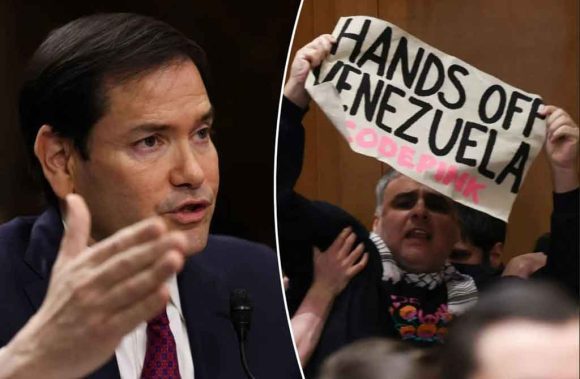
The Secretary of State, Marco Rubio, testified today before the Senate Foreign Relations Committee on US policy towards Venezuela, but his address was interrupted by a protest from the pacifist organisation Code Pink.
As he prepared to speak, a person in the audience raised a sign against the United States’ 3 January attack on Venezuela, which resulted in the death of over a hundred people and the kidnapping of the constitutional president Nicolás Maduro and his wife, MP Cilia Flores, both now held in a New York prison.
Security officers in the room where the hearing was taking place immediately removed the protester and Rubio continued with the session where he answered questions from legislators for the first time since the large-scale aggression ordered by President Donald Trump against the South American nation.
The head of US diplomacy defended, logically, the decision to attack without Congressional approval (the only body that approves the US entering a war) and maintained the rhetoric that led to the use of force against Venezuela.
He told legislators that the Maduro government represented an «unsustainable situation,» providing «an operating base for virtually all of the world’s competitors, adversaries and enemies.»
During the hearing, the Secretary of State raised the possibility of a new military operation in Venezuela if the current government does not assume certain commitments with Washington.
«We are prepared to use force to ensure maximum cooperation if other methods fail… We hope this will not be necessary, but we will never shirk our duty to the American people and our mission in this hemisphere,» he warned in his remarks prior to the question-and-answer session.
The senior official reiterated that the revenue generated from the sale of Venezuelan oil will continue under US control, deposited into an account managed by the Department of the Treasury.
«We will decide what this money can be spent on. They will present us with a budget request. Part of the revenue will be used to fund an audit process,» noted Rubio.
He considered that the transition to what Washington deems to be democracy «will take some time» and that such a purpose «we will not achieve in three weeks,» which reveals the intention to maintain presence and control over the oil and resource-rich country.
Trump’s comments that he would run Venezuela immediately raised questions about the Republican leader’s plans regarding that Latin American nation.
As part of its actions, the United States continued attacking vessels allegedly linked to drug trafficking in areas of the Caribbean and eastern Pacific, a military campaign that formed part of the pressure against Maduro and which, since 2 September when it began, has killed at least 126 people.
Then, in response to a question from Democratic Senator Chris Murphy, Rubio stated that there would be no US military presence in Venezuela beyond the marines providing security at an embassy.
Currently, the United States does not have a functioning embassy in the country, but could resume operations in the future. «The only military presence you will see in Venezuela are our marines at an embassy,» said Rubio.
«That is our goal. That is our expectation,» he added.
Despite his initial comments, he also assured senators «with absolute certainty» that the United States «is not prepared to, nor do we intend to or expect to have to take any military action in Venezuela at any time.»
Rubio Admits They Sought to Weaken Iranian, Russian and Chinese Influence in Venezuela
Venezuela’s President, Nicolás Maduro, had to leave his post, as the United States had no other option due to the need to end the influence of Iran, Russia and China in the country, declared the US Secretary of State, Marco Rubio.
«We wanted to weaken Iranian, Russian or Chinese influence in that country. None of that would have been possible while Maduro remained in power,» he affirmed during a hearing before the US Senate Foreign Relations Committee.
According to Rubio, «this was one of the options available to President Trump once it was considered that all other methods to remove this person from the political scene had been exhausted.» He was simply obstructing a great deal.
Furthermore, Rubio declared that the United States does not rule out carrying out a «preventive military operation» against Iran and will continue reinforcing its military presence in the Middle East.
US Does Not Rule Out a Preventive Military Operation Against Iran, According to Rubio
The United States does not rule out a preventive military operation against Iran and will increase its forces in the Middle East, declared US Secretary of State Marco Rubio before the Senate this Wednesday.
«With respect to our presence in the region, this is the starting point I want to set for everyone. The starting point is this: we have between 30,000 and 40,000 US troops deployed across eight to nine facilities in that region,» he stated.
According to Rubio, all those contingents are under direct threat. «All of them are within range, not theoretically, in reality, within range of a series of thousands of one-way unmanned aerial vehicles and short-range Iranian ballistic missiles, short-range ballistic missiles that threaten our troop presence,» he warned.
«The President [Donald Trump] always reserves the option of preventive defence,» he affirmed. «Essentially, if we have indications that, in fact, they are going to attack our troops in the region, [action will be taken] to defend our personnel in the region,» he explained.
In this context, the Secretary of State defended the review of the US disposition in the Middle East.
«I think it is sensible and prudent to maintain a force posture within the region that can respond and, potentially, it’s not that it will necessarily happen, but, if necessary, pre-emptively prevent an attack against thousands of American military personnel and other facilities in the region and against our allies,» said Rubio.
«I hope we do not reach that point,» he concluded.