
Five years since the death of filmmaker Enrique Pineda Barnet
This is how Enrique Pineda Barnet told it, more than once: «my friend Norka Méndez had arrived at my house, with Korda, the photographer, who was her husband, to announce to me that she was pregnant.» While they were celebrating, Fidel appeared on the television screen.
«Fidel spoke every day and they were always important speeches, so we started to listen and suddenly he says: We need young people of a certain cultural level who are willing to go to the Sierra as volunteer teachers.»
It was not yet about literacy volunteers, that campaign would come almost two years later. «I left Norka and Korda in the living room, and grabbed my file (inside was his documentation). Fidel was giving the speech at the corner of my house, on Channel 2, opposite what was the Montmartre Cabaret.
«There was a little soldier at the door and a little VW, the one Fidel drove. I told the little soldier to please deliver the file to the Commander when he came down. I returned to my house and when I entered, Norka and Korda were standing in front of the television and Fidel with the file in his hand saying: Here is the first volunteer teacher already!».
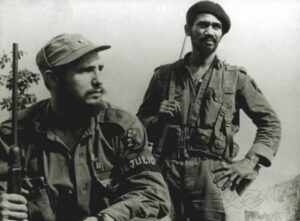
In that way the young man left for the Sierra Maestra: «Yes, I left, and my life began to be another from that moment (…). They sent me to a little school called El Cilantro, located on a mountain from where you could see the lights of Jamaica. With me, over 3,000 young people went up (…) there were no resources to teach, so it was done with anything (…) if the night was starry and the stars twinkled blue in the distance, they explained what the Moon was and, by the way, also poetry.
«The need to teach is as intense as the need to learn and the teacher learns at the same time as he is teaching,» he would affirm years later, in an interview given to the ACN, the director, screenwriter of cinema and videos, journalist, critic, broadcaster, actor of theatre, cinema and television, writer, composer and singer, who would never cease to be a teacher.
In the revolutionary maelstrom of those days, after the Sierra, they sent him to Matanzas, to the nationalisation of the Tinguaro sugar mill, and later to the office of the Minister of Foreign Relations, Raúl Roa. From there he arrived at the Cuban Institute of Cinematographic Art and Industry, that place he considered a dream, and which he thought he had no merits to join. His insertion into the Popular Encyclopedia department marked the start of a brilliant career within the Island’s cinematography.
Nevertheless, by that time Pineda Barnet (Havana, 28th of October 1933-12th of January 2021) had already been part of the Nuestro Tiempo Cultural Society, and of Teatro Estudio; a television pioneer, advertiser; and won the National Literature Prize Hernández Catá, in 1953, for his story Y más allá… la brisa. He also merited a mention in the Casa de las Américas prize 1960, with the theatre piece El Juicio de la Quimbumbia, and was among the founders of UNEAC.
Versatile and restless, he always attended to the search and to experimentation; to this owe works like Giselle, and La bella del Alhambra (Goya Prize 1990); besides – among many others – Aire Frío, Cosmorama, Mella, Aquella larga noche, La Anunciación, and Verde-Verde.
His pedagogical vocation was also demonstrated by the creation workshop Arca, Nariz, Alhambre, with young graduates from the Higher Institute of Art, from which relevant short films were born.
National Film Prize 2006 and Honorary Coral Prize of the 38th International Festival of New Latin American Cinema for his life’s work, 2016, Enrique Pineda Barnet’s call was to make cinema at all costs, through daring and unprejudiced films:
«I have said on several occasions that I have had an operation to remove hatred, because hatred is very harmful and does a lot of damage to the one who hates. The cure is to analyse the other, learn to understand them. The second is to learn to do without, because doing without equals clearing oneself (…) I believe that at the time of making art one must also learn with fewer resources, to squeeze creativity.»