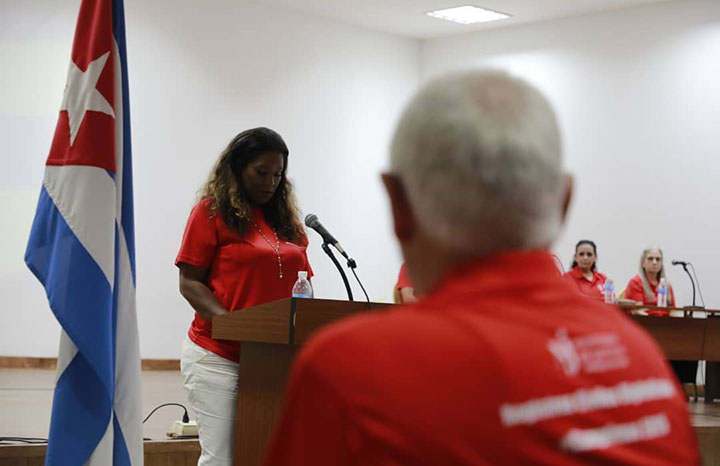
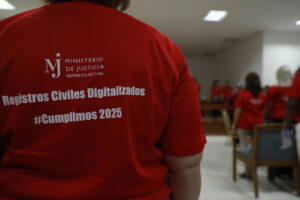
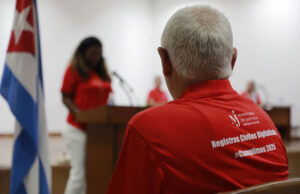
The achievement of digitising the entries of Cuba’s civil registries, a feat that consolidates digital sovereignty over these digital documents in the largest of the Antilles, was celebrated this Monday in Havana.
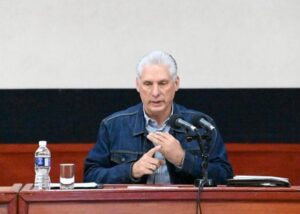
Attending the central event regarding this milestone, held in the Nicolás Guillén Hall of the «Morro-Cabaña» Military Historical Complex, were Julio César García Rodríguez, head of the Office for Attention to the Organs of the People’s Power System, the State and the Legal Sector of the Central Committee of the Communist Party of Cuba, Yamila Peña Ojeda, Attorney General, and Oscar Manuel Silvera Martínez, Minister of Justice, among other sector authorities and from organisations that contributed to the attainment of this crucial objective for the informatisation of society.
The Justice Minister expressed thanks in his keynote address to all those who, since 2008, undertook the task of transferring over 37 million folios to digital format and to the cooperation of the Illustrious Official College of Administrative Managers of Spain, which provided the means to considerably reduce the estimated time for achieving this feat.
Silvera Martínez indicated that they are currently immersed in concluding the process of uploading all scanned folios to the cloud, which, in his view, will allow the protection of information currently only collected on paper support, and an improvement in the quality of services provided by having all files available on the national Government platform «Sovereignty», with a view to eliminating to a certain degree unnecessary and redundant processing.
He added that all documentation is stored in accordance with Cuban legislation, especially that contemplated in Law 149/2022 «On Personal Data Protection», and therefore such records are not available to the general public and must necessarily be requested from any registry unit in the country, without it needing to be specifically where they were issued.
In the next stage we assume the challenge of digitising the rest of the registries (property, commercial, notarial protocols, compensation fund archives and all other pertinent documentation), and there is the willingness to provide the scanners to other institutions that propose to do the same from the shared vision of building one country, he noted.
Lissete Castillo Soler, Director of Natural Persons Registries, highlighted in this digitisation project a testament to Cuba’s determination not to be left behind and to advance towards technological sovereignty.
She specified that this is a decisive step towards creating secure digital environments where people’s data, and the nation as a whole, are protected from external threats, while also enabling the streamlining of procedures and establishing guarantees in the purpose of strengthening the foundations of the socialist State of Law and Social Justice.
On this day, we lay the foundations with a view to building a revolutionary tool: the single electronic folio; where every record in a citizen’s life from birth to death is interconnected, she affirmed.
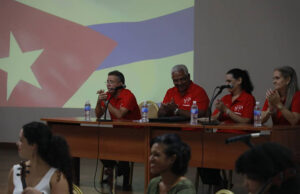
On the occasion of the celebration, tributes were presented to each of the provinces in the same order in which they completed the informatisation of the registries, with Guantánamo being the first, and to each of the entities that, under current conditions, contributed their input on that path, such as the Enterprise of Information Technologies for Defence (XETID), the Ministry of Public Health, the Youth Computer and Electronics Clubs, the local organs of People’s Power and the Cuban Telecommunications Enterprise S.A (ETECSA); and in a special manner to the Illustrious Official College of Administrative Managers of Spain.