A space for poetry, melody, image and reflection is making its way in Ciego de Ávila.
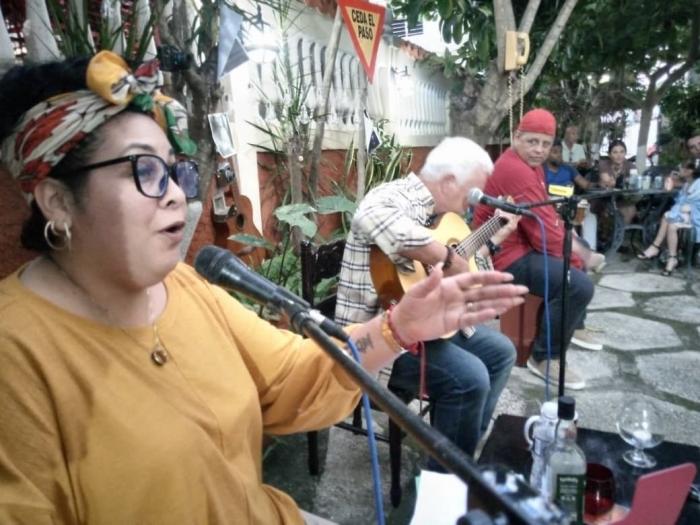
In the cultural panorama of Ciego de Ávila, often fragmented between nostalgia, silence and musical clamour, a proposal emerges that seeks, from its very name, to heal and nourish: the Ágape cultural gathering, conceived by the performer Oristela Pérez Betanzos and the troubadour Héctor Luis de Posada, which takes place on the first and third Thursday of each month, at four in the afternoon, in the courtyard of the Uneac headquarters.
More than a simple space to listen to music or recite verses, Ágape presents itself as a deliberate cultural banquet, an invitation for the spirit, which aims to fill a sensitive void in the city and seeks the resurgence of everyday cultural life, largely severed by COVID-19.
In an era of fast and digitally isolating cultural consumption, the concept of Ágape – which in its original Greek sense alludes to a banquet of love and camaraderie – is radical. Its primary utility is to re-establish face-to-face dialogue, the shared experience and communion around the beautiful and the thoughtful, such as music.
It is not a unidirectional spectacle, but a meeting to nourish poetry, melody, image and reflection. In a musical world that banishes vulgarity and cloying discourse, Ágape bets on quality and the depth of the experience, from the joined hands of its creators, two of the most recognised Avilanian troubadours, who take to the stage, free of charge, to offer musical chords and their hearts.
With the critical insight of one who knows the cultural pulse of the country, Héctor Luis de Posada speaks of the gathering’s birth and points to a lack that hurts in the Avilanian identity: «There is no place where one can go to see culture, as in other provinces: Villa Clara, Camagüey, Holguín, Santiago de Cuba…».
His questioning becomes even more concrete when directly addressing the city’s social life: «Why don’t we enliven the restaurants of Ciego de Ávila with the soloists, duos, trios of before?» It is clearly evident that there is a current fracture in which these spaces have renounced their role as hosts of local creation, depriving the community of that sonic fabric which, in the past, would enliven the simplest of dinners in the nearly disappeared restaurants that open their doors to the city’s nightlife.
The Avilanian capital sinks into a premature silence when the cinemas, theatres, restaurants – potential stages for gatherings and melodies – remain closed, and those that open, close at six in the evening; or sometimes, earlier. They thus thwart any possibility of evening entertainment. By switching off their lights, they deny a vital space to culture.
Ágape stands as a necessary space; an encounter that transcends the dichotomy between «high culture» and «neighbourhood culture». By offering a diverse yet curated programme – which can range from a contemporary poetry recital and a bolero, to a visual arts exhibition, reflective trova, or the rescue of Latin American folklore – the gathering also builds bridges. Its utility lies in demonstrating that these expressions are not exclusive, but facets of the same human need to create and to be moved.
Oristela Betanzos points to the «very great apathy» that weighs on Ciego de Ávila and the loss of musical spaces, but the true value of her words resides in the final turn. In that «I cannot just stay lying down,» which transforms criticism into a manifesto of creative resistance. (Author: Ortelio González Martínez)